Based on 46 reviews


 Trustindex verifies that the original source of the review is Google.
 Trustindex verifies that the original source of the review is Google.
 Trustindex verifies that the original source of the review is Google.
 Trustindex verifies that the original source of the review is Google.
 Trustindex verifies that the original source of the review is Google.
 Trustindex verifies that the original source of the review is Google.
 Trustindex verifies that the original source of the review is Google.
 Trustindex verifies that the original source of the review is Google.
 Trustindex verifies that the original source of the review is Google.
 Trustindex verifies that the original source of the review is Google.

Based on 46 reviews
Trustindex verifies that the original source of the review is Google. Trustindex verifies that the original source of the review is Google. Trustindex verifies that the original source of the review is Google. Trustindex verifies that the original source of the review is Google. Trustindex verifies that the original source of the review is Google. Trustindex verifies that the original source of the review is Google. Trustindex verifies that the original source of the review is Google. Trustindex verifies that the original source of the review is Google. Trustindex verifies that the original source of the review is Google. Trustindex verifies that the original source of the review is Google. 

Heating the Roof?
Your Energy Bills Could Go Through It Too.
When Jack Frost is up to no good, commercial heating systems soon show their weak spots. The unit that ‘just about coped’ last year suddenly looks less heroic. The loading door might as well be propped open to Norway. And somewhere above the racking, a lovely layer of warm air can be keeping the roof steel cosy while the people below reach for another fleece.
So before the cold really sets in, ask four quick questions: is the system ready, where is the heat going, are you using it intelligently and – if the plant is ageing – what could you gain from a new high-efficiency system, properly designed and installed?
Potentially, quite a lot..
Winter has a habit of finding the weak spots.
The worst time to discover a heating problem is the first morning everybody needs the heating. By then every facilities team has had the same idea and engineers are suddenly rather popular.
A pre-season check can catch the obvious faults. It can also expose a system running longer than it needs to, heating empty zones or following a control strategy that belonged to a different version of the building. Turning the thermostat up may feel decisive, but it can be about as useful as ordering another heater while the roller shutter is still wide open.
Where is the heat actually going?
A warehouse is not an office with a bigger roof. High ceilings, large footprints, variable occupancy and frequently opened doors all make even temperatures harder to achieve.
Warm air rises, so useful heat can collect at high level while occupied areas below remain cooler. But pushing everything back to floor level is not always the answer. Mezzanines, packing decks,
racking, partitions and machinery change how air moves – and some upper levels
need heating in their own right.
The point is simple: put the right heat where the building and people need it, when they need it.
Before making more heat, use what you have already paid for
Sometimes the smartest improvement is not another heater. If one zone is empty, why heat it? If a loading door is open, why let expensive warm air disappear outside while your bank balance heads the same way? If heat is sitting at high level, why make more before bringing it back into circulation?
This is where zoning, timers, thermostatic and BMS controls, optimised start settings, destratification fans and air curtains earn their keep. A good control strategy makes a sophisticated heating system behave intelligently. A bad one can turn it into an expensive wall decoration. Powrmatic, for example, uses optimised-start controls on current warm-air ranges, while its CECx destratification fans recirculate high-level hot air back into the working zone.
Your building has changed. Heating technology has too.
Racking changes. Production moves. Shift patterns alter. New machinery changes the internal heat load. Yet the heating may still be following a design drawn up years ago.
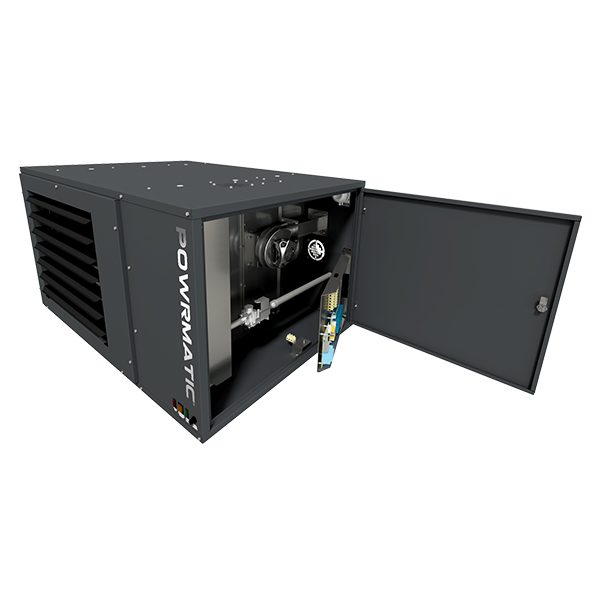
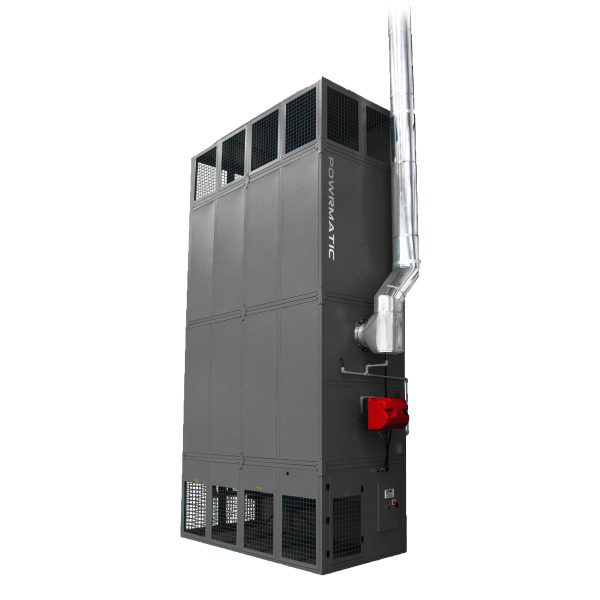
Gas and oil-fired warm-air heating still has an important place in factories, warehouses and workshops. But modern equipment is a long way from the old ‘on or off’ approach. High/low or modulating burners, better controls and improved air distribution all help. Powrmatic’s CPx cabinet range, for example, lists thermal efficiency of at least 91.5% on a net calorific value basis, with outputs up to 586kW.¹
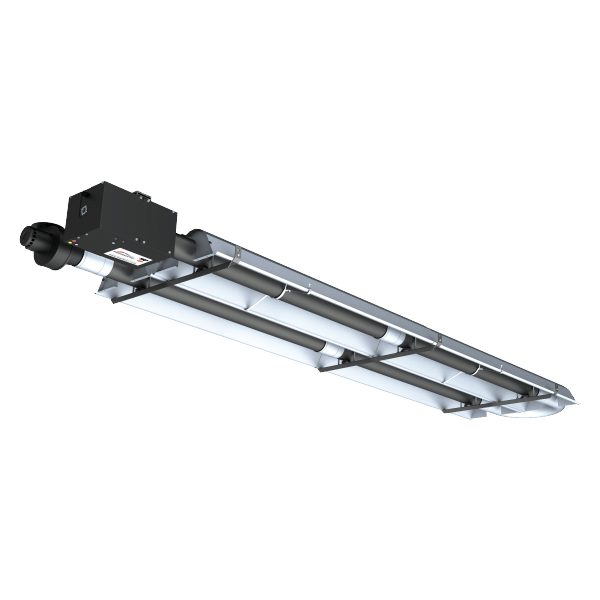
Warm air is only one route. Radiant systems can heat people and surfaces without warming every cubic metre of air. Air-rotation heaters can suit very large open spaces. Electric radiant heating has a growing role. Air-to-air heat pumps can provide heating and cooling from one system.
Clean Air works with manufacturers including Powrmatic, Reznor, Mitsubishi Electric, Daikin, Fujitsu and Nortek, and holds Mitsubishi Electric Diamond Quality Partner and Daikin D1 Partner status. The advantage is choice: the building should not be made to fit a favourite product.
Don’t automatically replace like-for-like
When an ageing heater reaches the end of its life, replacing it with the modern equivalent can seem obvious. Sometimes it is. Sometimes it is the facilities-management equivalent of replacing the same flickering fluorescent tube again and wondering why the lighting is still awful. A new system may work well into the 2030s, so running costs, reliability, controls, electrical capacity, maintenance, carbon reduction and future use all matter.
The regulations are changing too. From March 2027, the Future Homes and Buildings Standards will introduce new requirements for new non-domestic buildings in England, subject to transitional provisions. The direction is clear: lower carbon heating and energy efficiency increasingly matter in new building design. [2]. That does not mean every existing warehouse needs ripping apart. But simply buying a newer version of what was there before deserves proper challenge.
Start with the building, not the heater
There is no single ‘best’ commercial heating system – buildings simply do not work like that.
Clean Air has been providing commercial HVAC advice and expertise since 1989. The process starts with the building: how it is used, where heat is lost, where people work, what temperature control is needed and what the investment needs to achieve. Then come the load calculations, system design and plant specification.
Survey first. Specify second. Choose the equipment third.
Because the wrong heating system can be an expensive mistake – however much of a ‘hot bargain’ the quote looked when it landed in your inbox.
So, is your heating winter-ready – or is it time to rethink it?
Arrange a free site survey with Clean Air.
Source Notes
1. Powrmatic CPx Warm Air Cabinet Heater specification: minimum 91.5% thermal efficiency (Nett CV); outputs up to 586kW. Product performance varies by model and installation.
2. UK Government, Future Homes and Buildings Standards, published 24 March 2026; main requirements for new non-domestic buildings in England from 24 March 2027, subject to transitional provisions.
3. Clean Air Group heating/about pages: current technologies, manufacturer relationships and partner accreditations; Powrmatic CECx specification: high-level heat recirculation/destratification.
⇓ Download Commercial Heating blog
Call Clean Air today: Call 01327 301383